
Products
Safe, Compliant & Sustainable Chemistry

Linear Alkylbenzene Sulfonic Acid
- Product Name: Linear Alkylbenzene Sulfonic Acid
- Factroy Site: Yudu County, Ganzhou, Jiangxi, China
- Price Inquiry: sales4@ascent-chem.com
- Manufacturer: Ascent Petrochem Holdings Co., Limited
- CONTACT NOW
- Characterized by its high anionic surface activity and rapid biodegradability, it functions as a primary surfactant intermediate in the household and industrial detergent industry and conforms to GB/T 8447.
| HS Code | 612258 |
| Chemical Formula | C18H30O3S |
| Molecular Weight | 326.49 g/mol |
| Appearance | Dark brown viscous liquid |
| Odor | Characteristic pungent sulfonic acid odor |
| Density | 1.06 g/cm³ at 20°C |
| Viscosity | 1000-2500 mPa·s at 20°C |
| Acid Value | 95-105 mg KOH/g |
| Ph | 1-2 in aqueous solution |
| Solubility | Soluble in water and polar organic solvents |
| Flash Point | >150°C |
| Boiling Point | Decomposes before boiling |
| Melting Point | -10°C to 10°C |
As an accredited Linear Alkylbenzene Sulfonic Acid factory, we enforce strict quality protocols—every batch undergoes rigorous testing to ensure consistent efficacy and safety standards.
| Packing | Packaged as 200 kg net in 220 L HDPE drums; viscous amber liquid requiring secure storage away from bases. |
| Container Loading (20′ FCL) | 20′ FCL: 80 drums or 20 IBCs, palletized, strapped, protected from moisture, with proper segregation for acid loading. |
| Shipping | Linear Alkylbenzene Sulfonic Acid is shipped in HDPE drums, IBC totes, or bulk tankers. It is corrosive and requires acid-resistant linings, proper ventilation, and segregation from bases. Transport by road, rail, or sea under UN 2585, with hazardous goods labeling and spill containment protocols. |
| Storage | Store Linear Alkylbenzene Sulfonic Acid in corrosion-resistant containers, preferably stainless steel or plastic-lined drums, tightly sealed. Keep in a cool, dry, well-ventilated area away from moisture, direct sunlight, and heat. Avoid contact with strong oxidizers, bases, and metals. Maintain temperatures between 20–30°C to prevent degradation and ensure product stability. |
| Shelf Life | Shelf life is typically 12–24 months when stored in a sealed container, away from heat, moisture, and direct sunlight. |
What drives selection of 96% vs. 90% concentration in heavy-duty alkylbenzene sulfonate when spray-dryer wall fouling becomes the primary throughput limiter?
Commercial linear alkylbenzene sulfonic acid (HLAS) is typically delivered at 96% active matter, with the 90–93% grades available for customers who prioritize pumping viscosity over freight efficiency. In large-volume sulfonation plants feeding detergent spray towers, the 96% acid is neutralized continuously with 48–50% sodium hydroxide in a loop reactor equipped with a pH-controlled recirculation stream at pH 7.5–8.5 and a temperature ceiling of 55°C; exceeding 60°C initiates autoxidation that darkens the paste and generates odor-active sulfones. The resulting sodium alkylbenzene sulfonate (Na-LAS) slurry, adjusted to 55–65% active matter, is post-dosed into a slurry crutcher alongside sodium carbonate, sodium silicate (SiO₂:Na₂O ratio 1.6–2.0), sodium sulfate filler, and zeolite 4A builder. Spray-drying inlet temperatures of 280–350°C and outlet temperatures of 100–120°C demand that the LAS paste maintain a glass transition viscosity above 50 Pa·s at 85°C to prevent particle collapse; formulations that fall below this threshold yield hollow spheres with poor bulk density (300–350 g/L) and unacceptable fines generation. Wall-sticking on rotary atomizer towers correlates with residual free oil content exceeding 1.5%, measured by petroleum ether extraction per ASTM D2357, and is remedied by increasing the SO₃:LAB molar ratio in the upstream falling-film sulfonator to 1.03:1. The finished heavy-duty powder must meet stain removal index thresholds on EMPA 101 and 117 swatches under ISO 6330:2021 wash protocols, with LAS concentrations in the wash liquor held at 200–400 ppm active surfactant.
In liquid laundry formulations structured with lamellar phases, what stabilizes the isotropic zone above 40°C and prevents viscosity collapse at an electrolyte content exceeding 3%?
The pseudo-ternary phase diagram of Na-LAS, water, and short-chain alcohol ethoxylates defines the processing window for household liquid laundry products. Monoethanolamine (MEA) neutralization of HLAS—proceeding at 1.02–1.05 stoichiometric equivalents MEA per sulfonate group—produces a hydrotrope-free liquid of 40–50% active matter with a pour point below −5°C, a property not achievable with sodium-neutralized paste at identical actives. Viscosity regulation across the 25–45°C storage and usage band relies on the incorporation of sodium xylene sulfonate (SXS) at 1.5–4.0% of total surfactant weight, which shifts the critical packing parameter below 0.5 and disrupts the hexagonal liquid-crystalline phase that would otherwise immobilize the product at ambient temperature. Enzyme compatibility—protease subtilisin (EC 3.4.21.62) and mannanase—requires a borax-sorbitol inhibitor system buffered to pH 7.0–7.5; free LAS monomer at concentrations above 1.0 mM in the continuous phase causes irreversible unfolding of the protease alpha-helix structure within 72 hours at 37°C, measured by residual activity assay per ASTM D154. Fragrance microencapsulation in melamine-formaldehyde shells survives shear rates up to 20,000 s⁻¹ in the in-line static mixer, but shell rupture increases by 8–12 percentage points when total surfactant exceeds 45% due to interfacial tension reduction below 1 mN/m. Formulations must register with the European Detergents Regulation (EC) No 648/2004 Annex VII and meet the OECD 301B ready biodegradability threshold of >60% oxygen consumption within 28 days.
| SXS Content (wt% of surfactant) | Viscosity at 25°C (mPa·s, 20 rpm, Spindle #4) | Clarity at 5°C (NTU, 7-day stability) | Phase at 40°C (optical microscopy) |
|---|---|---|---|
| 0.0 | >50,000 (gel) | — (immobilized) | Hexagonal LC + crystals |
| 1.0 | 8,500–12,000 | 42–58 | Lamellar Lα |
| 2.5 | 800–1,200 | 7–14 | Isotropic L₁ |
| 4.0 | 150–300 | 2–5 | Isotropic L₁ |
| 5.5 | 90–170 | 1–3 | L₁ (near cloud point) |
Polymers for anti-redeposition—carboxymethylcellulose (DS 0.6–0.8) at 0.5–1.5% of dry weight or soil-release polyester copolymers at 0.3–0.7%—are prehydrated at 60°C before LAS addition to avoid polymer-surfactant complex precipitation at low ionic strength. The finished product is filled at 20–25 s⁻¹ shear rate, and fill-head drip is controlled when dynamic surface tension (measured via maximum bubble pressure method) remains above 35 mN/m at a surface age of 100 ms.
Emulsion Polymerization: Micellar Nucleation with LAS as Primary Anionic Emulsifier in Styrene-Acrylic Latex Synthesis
Chain-growth emulsion polymerization of styrene/n-butyl acrylate (St/BA 50:50 by weight) uses LAS at 1.2–2.5 parts per hundred monomer (phm) as the sole primary emulsifier. The sodium salt is preferred post-neutralization to minimize acid-induced destabilization of the potassium persulfate initiator system; residual sulfuric acid from the sulfonation step, quantified as free sulfuric acid by ISO 6844, must remain below 0.5 wt% on the 96% acid feed or be stripped via anhydrous sodium sulfate addition prior to neutralization. Nucleation mechanism is micellar: the critical micelle concentration (CMC) of C10–C13 LAS in the aqueous phase at 80°C is approximately 2.8 × 10⁻³ M, and emulsifier concentration is maintained at 8–15 times CMC during the nucleation phase (first 15–20% conversion) to generate a final latex particle count of 10¹⁵–10¹⁶ particles per milliliter. Particle size distributions characterized by laser diffraction (ISO 13320:2020) yield volume-median diameters of 120–180 nm with polydispersity index below 0.08. Homolog distribution of the alkylbenzene precursor—specifically the weight ratio of 2-phenyl isomers to total alkylate, measured by GC-MS per ASTM D4337—affects interfacial packing density and controls the onset of secondary nucleation at monomer conversion exceeding 70%; ratios above 0.25 promote broader particle size distributions. Coagulum formation in the reactor, measured as residue retained on a 100-mesh screen, is kept below 0.1% of total latex solids. The finished latex, applied as a binder in architectural flat paints per GB/T 20623-2006, exhibits wet scrub resistance improving by 15–25% relative to carboxylate-emulsified analogues when LAS-derived surfactant migration is controlled by post-polymerization neutralization with calcium hydroxide to precipitate the LAS as the insoluble calcium salt within the dried film.
Post-spray acid neutralization for industrial parts washing diverges sharply from household formulation norms, because the performance driver shifts from foam quality to aluminium alloy compatibility at elevated temperatures. Non-corrosive aqueous degreasers based on HLAS for aluminium substrates (specifically AlMgSi1 per EN AW-6082) neutralize the sulfonic acid exclusively with triethanolamine (TEA) at an equivalent ratio of 1.00–1.02 moles TEA per mole —SO₃H group, producing a pH in concentrate of 7.0–7.4 and a dilution to 4–8% active matter at the point of use. The pyran-type hydroxyl on TEA chelates aluminium ions released during the alkaline displacement step, suppressing intergranular corrosion that manifests as pitting under scanning electron microscopy at operating temperatures of 65–80°C in immersion baths. LAS concentration at the substrate interface is maintained at 0.1–0.3 wt%; exceeding 0.5 wt% on Al2024-T3 results in mass loss rates above 2.5 mg/cm²/hour per ASTM G31-72. Silicate inhibition (sodium metasilicate pentahydrate, 1–2% in concentrate) builds a passivation film on cleaned surfaces when the SiO₂:Al³⁺ ratio in the bath exceeds 5:1 by ICP-OES monitoring. The cleaning index, assessed by modified ASTM D4488 on carbon black/mineral oil soiled coupons, must exceed 85% soil removal within 8 minutes at 70°C. Disposal compliance mandates ready biodegradability test results conforming to OECD 301F, with LAS achieving > 60% theoretical CO₂ evolution in 28 days and primary degradation (methylene blue active substance loss) exceeding 95% within 7 days under the test conditions specified in ISO 7827.
Agricultural emulsifiable concentrate (EC) and suspo-emulsion (SE) formulations rely on HLAS in its calcium-neutralized form (Ca-LAS, branched or linear) as a co-emulsifier anchoring the oil-phase droplet interface at 50–80 g/L in the concentrate. The driving selection criterion is the requirement for rapid in-can emulsion bloom upon dilution to 1–2% v/v in hard water of 342–1,000 ppm CaCO₃ equivalent per CIPAC MT 36.3. Ca-LAS with a linear alkyl chain length distribution peaking at C11–C12 aligns its hydrophobic tail with the pesticide solvent (typically heavy aromatic naphtha, Aromatic 150 or Aromatic 200 cut), while the calcium-sulfonate head group exhibits lower aqueous solubility than sodium analogues, saturating interfacial concentration at 0.5–1.0% in the diluted spray and resisting stripping by competing hard-water cations. Emulsion stability is measured by spontaneous emulsification performance at 30°C in 342 ppm standard hard water; separation of 0.2 mL or less of cream after 2 hours meets the criterion for a stable emulsion per CIPAC MT 36.1.1. Rheology of the concentrate at low-shear (Brookfield, 20 rpm) must not exceed 800 mPa·s at 25°C to enable pour-meter accuracy; combined LAS and non-ionic block copolymer co-emulsifier loading exceeding 12% total triggers viscosity spikes due to inverse micelle formation in the aromatic solvent phase. Dilute emulsion droplet size distributions, measured by laser diffraction, yield a volume-median diameter of 3–8 µm. Formulations must comply with FAO/WHO Specification Guidelines under the International Code of Conduct on Pesticide Management and must not exceed 0.1% free phenol in the sulfonate per analytical method MT 171.
Textile scouring and the re-wetting envelope: how does LAS manage oxidative desizing byproducts while avoiding peroxide destabilization in a continuous open-width range?
Continuous open-width preparation of woven cotton/polyester blends employs HLAS-neutralized with potassium hydroxide (KOH) to generate the potassium salt with a Krafft point below 10°C, critical for low-temperature (40–50°C) exhaustion onto the fiber. Scouring formulations combine 1.5–3.0 g/L K-LAS with 4–8 g/L sodium hydroxide and 6–12 g/L hydrogen peroxide (35% solution), stabilized by sodium silicate (2–4 g/L) and magnesium sulfate (0.1–0.3 g/L) acting as a peroxide chelate stabilizer. Divalent metal ions—iron, copper, manganese—catalyze peroxide decomposition with activation energies below 50 kJ/mol; LAS sulfonate groups complex these metals weakly, rendering LAS less antagonistic to H₂O₂ stability than linear alkylbenzene hydrotropes with carboxylate functionalities. The critical constraint is that LAS addition must follow peroxide preheating to 60°C, because direct mixing of concentrated acid forms with alkaline H₂O₂ generates localized exotherms exceeding 95°C that cause pinhole formation on polyester fibers visible under 40× microscopy. Re-wetting of desized and scoured fabric is quantified by the AATCC Test Method 79 drop test, with values below 3 seconds required before downstream mercerization. Residual LAS on fabric after standard two-stage hot-water rinse (85°C overflowing washer) must not exceed 0.05% on weight of fiber, measured by methylene blue titration of the final rinse bath, to prevent foam in subsequent continuous dyeing with dispersed dyes at 130°C. Effluent loads from textile scouring containing LAS must comply with the ZDHC Manufacturing Restricted Substances List (MRSL) v3.1 limits for alkylphenol ethoxylates (not detected at 100 ppm detection limit) and must be processed through an activated sludge treatment with HRT exceeding 8 hours for primary biodegradation of the LAS linear alkyl chain.
| Neutralizing Agent | Active Form | Typical Concentration Post-Reaction | Krafft Point (°C) | Critical Compatibility | Dominant Application |
|---|---|---|---|---|---|
| Sodium hydroxide | Na-LAS | 55–65% paste | ~18–22 | Avoid high SO₄²⁻ above 2%; precipitates at <10°C | Spray-dried powder, industrial cleaners |
| Monoethanolamine | MEA-LAS | 40–50% liquid | <−5 | Primary amine may cause yellowing above 45°C storage | High-active liquids, compact unit dose |
| Triethanolamine | TEA-LAS | 60–70% concentrate | <−10 | Al substrate passivation; avoid chlorinated solvents | Metal degreasing, aluminium-safe cleaners |
| Potassium hydroxide | K-LAS | 45–55% paste | <10 | Superior low-temp solubility vs. Na-LAS; costs 1.3–1.5× Na-LAS | Textile scouring, cold-water detergents |
| Calcium hydroxide | Ca-LAS | 30–50% in hydrocarbon | Insoluble (oil-phase anchor) | Limited water solubility; use as co-emulsifier | Agrochemical EC, adjuvant oils |
Explicit operational boundaries govern HLAS handling regardless of downstream sector. Concentrated acid is stored in 316L stainless steel or high-density polyethylene tanks at temperatures above 25°C to prevent sulfonic acid ester crystallization, which occurs in the linear C10–C13 homolog range at gel points between 15–22°C depending on 2-phenyl isomer content. Water ingress into storage vessels must be limited to below 0.5%, because the exothermic hydration reaction generates temperature rises exceeding 15°C/minute and accelerates sulfone formation via acid-catalyzed dehydration. Neutralization heats reach 105 kJ/kg of sulfonic acid; practical plants limit addition rates to control localized boiling in the dilute phase and prevent aerosolization of un-neutralized acid mist. All neutralized LAS products imported into the European Economic Area require REACH registration under EC No. 1907/2006, with the LAS SIEF (Substance Information Exchange Forum) having established a reference chronic no-observed-effect concentration (NOEC) of 1.2 mg/L for Daphnia magna reproduction (OECD 211, 21-day exposure). Claims of enhanced biodegradability for LAS homologs must be validated against ISO 14593 (CO₂ headspace test) with a 60% pass threshold in 28 days, and against the anaerobic test OECD 311 for products destined for septic-tank-compatible cleaning agents. Published data on anaerobic half-lives for LAS in sludge digesters with 15-day SRT at 35°C spans 7–20 days depending on the headspace hydrogen partial pressure, which influences beta-oxidation kinetics of the alkyl chain by syntrophic bacteria.
LABSA 90 vs LABSA 96: Specifications, Uses and Price Differences
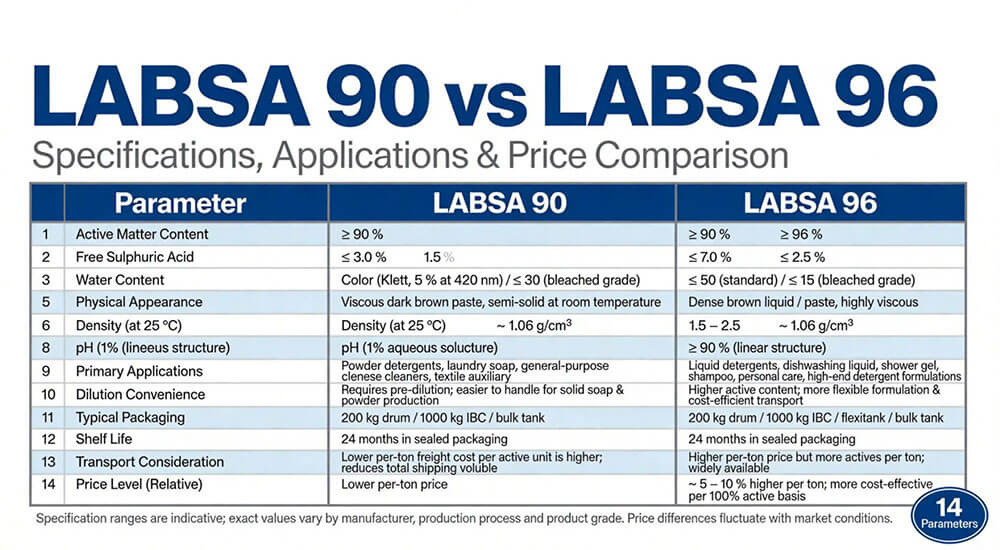
LABSA is commercially available in different grades, including LABSA 90% and LABSA 96%, depending on active matter and application requirements.
Competitive Linear Alkylbenzene Sulfonic Acid prices that fit your budget—flexible terms and customized quotes for every order.
For samples, pricing, or more information, please contact us at +8618136850665 or mail to sales4@ascent-chem.com.
We will respond to you as soon as possible.
Tel: +8618136850665
Email: sales4@ascent-chem.com
Get Free Quote of Ascent Petrochem Holdings Co., Limited
Flexible payment, competitive price, premium service - Inquire now!
- Linear Alkylbenzene Sulfonic Acid is manufactured under an ISO 9001 quality system and complies with relevant regulatory requirements.
- COA, SDS/MSDS, and related certificates are available upon request. For certificate requests or inquiries, contact: sales4@ascent-chem.com.
Product Identity and Typical Commercial Specifications
The material is a mixture of sulfonic acids of 2-phenyl, 3-phenyl, and higher internal phenylalkane isomers, with an average molecular weight of 326.5 ± 5 g/mol for a C₁₀–C₁₃ chain distribution centered around C₁₁.6. Specification sheets for the two dominant trade forms, LABSA 96 and LABSA 90, routinely reference the two-phase titration method of ISO 7875-1 for anionic active matter quantification and ASTM D4711 for unsulfonated organic matter. A typical quality profile is summarized below.| Parameter | LABSA 96 Grade | LABSA 90 Grade | Test Method |
|---|---|---|---|
| Active matter (as H-LAS) | ≥ 96.0% w/w | ≥ 90.0% w/w | ISO 7875‑1 |
| Free oil (unsulfonated LAB) | ≤ 1.5% w/w | ≤ 2.5% w/w | ASTM D4711 |
| Free sulfuric acid | ≤ 1.5% w/w | ≤ 3.0% w/w | Acid-base titration |
| Water content (Karl Fischer) | ≤ 1.0% w/w | ≤ 2.0% w/w | ISO 760 |
| Color (Klett, 5% active) | ≤ 40 | ≤ 80 | Spectrophotometric |
How Does LABSA Differ from Branched Alkylbenzene Sulfonic Acid?
Prior to the mid-1960s, the dominant sulfonic acid for detergent manufacture was branched alkylbenzene sulfonic acid (BAS), derived from propylene tetramer. That material exhibits a quaternary carbon branching pattern that resists β-oxidation in aerobic wastewater treatment. Published data under OECD 301B (ready biodegradability) shows that LAS derived from linear alkylbenzene reaches 60–70% ThOD within 28 days, whereas branched alkylbenzene sulfonate often remains below 20%. This disparity is the primary driver of the global regulatory shift toward linear feedstocks, codified in detergent regulation EC 648/2004 and earlier legislation. From a physicochemical standpoint, the linear acid imparts a lower Krafft point for its sodium salt (≈ 0–10 °C depending on chain length distribution) compared with the branched analogue, which can exhibit Krafft points exceeding 20 °C, thereby limiting cold-water solubility. Furthermore, the critical micelle concentration of sodium LAS is about 400 mg/L (0.012 mol/L) at 25 °C, while the branched variant typically exhibits a CMC near 200 mg/L; the higher CMC reduces viscosity build in structured liquids and requires a different electrolyte adjustment in formulation.When Spray-Dried Detergent Powders Are Exposed to Acidic Over-Spray
In heavy-duty laundry powder manufacturing, LABSA is frequently applied as a post-addition to a tower-dried base bead containing sodium carbonate and sodium silicate. The acid spray-on process must be controlled within a narrow operational window. If the acid feed rate exceeds 150 kg/h per tonne of base powder on a conical mixer with an L/D ratio of 1.8–2.2, localized pH depression below 8.5 triggers rapid CO₂ release from carbonate, generating fine airborne dust and causing non-homogeneous agglomeration. Equipment typically used is a continuous Ploughshare mixer (e.g., Lödige FM series) with a jacket temperature maintained at 35–40 °C to balance acid neutralization exotherm while preventing premature water evaporation that would lead to surface crusting. Typical acid addition levels range from 2.5% to 6.0% by weight of finished powder. At addition levels above 6.0%, the powder’s moisture uptake under 80% RH at 25 °C can exceed 4% within 2 hours, triggering caking and flow obstruction in silo discharge. When this threshold is approached, formulators often substitute part of the acid load with pre-neutralized LAS paste, sacrificing some cost efficiency for storage stability. Direct neutralization of LABSA within liquid laundry detergent blends proceeds in situ. In a typical batch vessel with a high-shear rotor-stator disperser operating at 1,500–3,000 rpm, a 20–25% aqueous sodium hydroxide solution is metered into the acid at a rate that keeps the bulk temperature below 45 °C. The neutralization is exothermic, liberating approximately 150 kJ per kg of active matter; failure to dissipate this heat causes localized gel formation because LAS paste at 50–52% active matter undergoes a steep viscosity increase—rising from 500 mPa·s to over 15,000 mPa·s—if the water content drops below 46%. This gel phase, once formed, hinders mixing and may permanently overload a standard 15 kW agitator drive. Consequently, plant operators monitor conductivity and refractive index in‑line to maintain the water-to-active ratio within a ±2% control band.Neutralization Exotherm Control in Continuous LAS Paste Production
Large-scale LAS paste production—yields of 10–30 tonnes/hour—utilizes continuous neutralization loops combining static mixers and water-cooled shell-and-tube heat exchangers. A typical configuration feeds LABSA 96 at 80–90 °C from the sulfonation plant into a recycle loop where it contacts a diluted sodium hydroxide stream (20–22% w/w) in a static mixer element of 10–12 L/D. The paste recycle ratio is maintained between 15:1 and 25:1 to limit the adiabatic temperature rise to less than 8 °C per pass. Cooling water at 15–20 °C removes the exotherm downstream, and the final product exits at 40–50 °C with a viscosity of 2,000–4,000 mPa·s for a 50% active sodium LAS paste. Deviations in the recycle ratio due to pump wear can narrow the operating window to ±5 °C; exceeding 55 °C accelerates hydrolysis of residual sulfone intermediates, increasing free oil content by 0.2–0.5% within 30 minutes and shifting the paste color from pale yellow to amber. Industrial and institutional cleaning formulations exploit the acid form directly in highly alkaline aqueous solutions where in‑line neutralization is instantaneous. In an open-plant floor scrubbing concentrate containing 8% active LABSA and 2% sodium metasilicate, the exotherm raises the bulk temperature by 6–9 °C in a 5,000 L atmospheric vessel equipped with dip-pipe agitation. The final solution remains clear at 25 °C provided the total dissolved solids do not exceed 18%; beyond this, sodium sulfate precipitation occurs if hard water calcium ions exceed 150 mg/L as CaCO₃, a practical limit set by field experience from floor-scrubber service cycles in food processing facilities.Emulsification Performance vs. Secondary Alkane Sulfonates
A comparative assessment against secondary alkane sulfonates (SAS, also supplied as sulfonic acids) highlights characteristic trade-offs. SAS exhibits faster wetting on cotton (Draves test, ASTM D2281: sinking time <10 s at 0.1% active) compared with 15–25 s for sodium LAS of equivalent chain length. However, the linear alkylbenzene sulfonic acid, once neutralized, generates a superior emulsification index for vegetable oil/mineral oil mixtures under ISO 6614 conditions—emulsion stability exceeding 80% after 24 h versus 55–65% for SAS at identical active levels. This property anchors LABSA-derived LAS in heavy-duty degreasers formulated for automotive parts washing, where a 5% active LAS solution at pH 9.5–10.5 suspends carbonized oil residues without splitting even after 48 hours of recirculation through 120 μm bag filters.| Property | LABSA (as Na‑LAS) | Branched Alkylbenzene Sulfonate (BAS) | Secondary Alkane Sulfonate (SAS, C₁₃–C₁₇) |
|---|---|---|---|
| Ready biodegradability (OECD 301B, 28‑day) | >60% ThOD | <20% ThOD | >60% ThOD |
| Krafft point (1% active Na salt) | 0–10 °C | 20–28 °C | <0 °C |
| CMC in deionized water (25 °C) | ~400 mg/L | ~200 mg/L | ~300 mg/L |
| Calcium tolerance (as CaCO₃) | ~200 mg/L | ~180 mg/L | ~1,500 mg/L |
| Viscosity of 50% active Na salt (mPa·s, 25 °C) | 2,000–4,000 | 1,000–2,500 | <500 |